 RSGB News
Lee G0MTN now has more time to go contesting – and why not start by entering the Earth-Moon-Earth contest!
Here’s his report…..
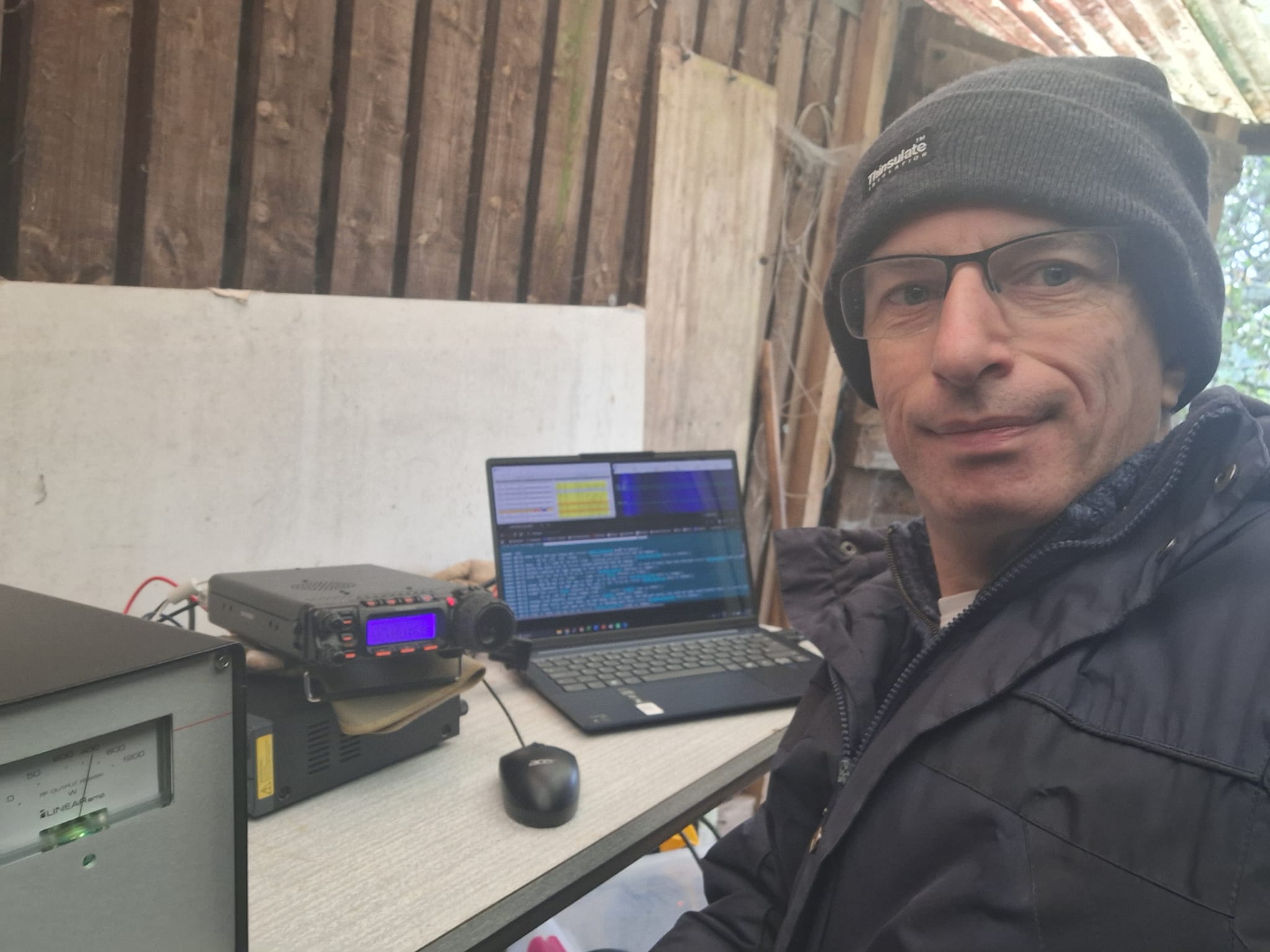
Whilst WRTC 2026 planning was underway I hadn't really had much time to try moon-bounce operating, or EME (Earth-Moon-Earth).
I don't have a permanent set up, and both getting everything ready and operating does take some time and patience.
I'd spotted that one of the weekend legs of the ARRL EME contest was coming up, where there would be more activity than usual. It's also important to check the moonrise and moonset times just in case the moon would only be above the horizon at some very antisocial times.
There was a window of a few hours on Sunday morning before moonset when I would have some free time.
My 144 MHz EME station is kept in some plastic storage boxes, and moved out to a not-completely watertight shed at the end of the garden.
A small coax feeder run and minimal losses are essential for moon-bounce operation. I run a long extension cable out from the house to power the station.
The radio is a trusty Yaesu FT857, which is dwarfed by a Linear Amp UK linear amplifier, which also cleverly manages the sequencing for the vital receive pre-amplifier at the antennas.
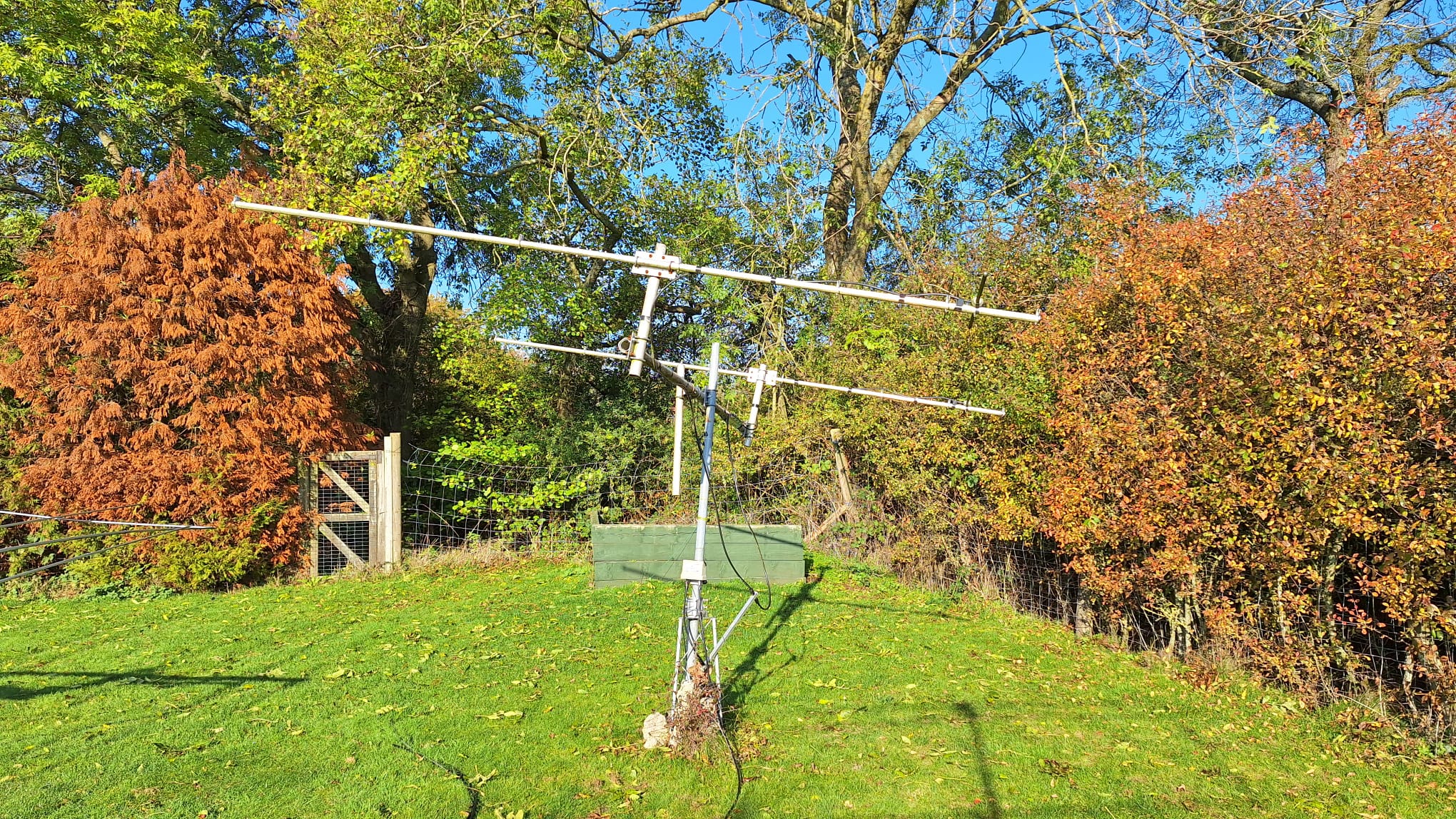
The antennas are two 8 element yagis bayed horizontally, connected via a splitter.
All rotation and elevation is carried out by hand, which makes things much simpler. A phone app helps to work out where to point the antennas which is useful when there is cloud in the sky and the moon can't be seen visually.
The amplifier is run at about 600 watts, which delivers just over 500 watts to the antennas. This is within the power handling limit for the pre-amp, and also helps to not over-stress the linear amplifier.
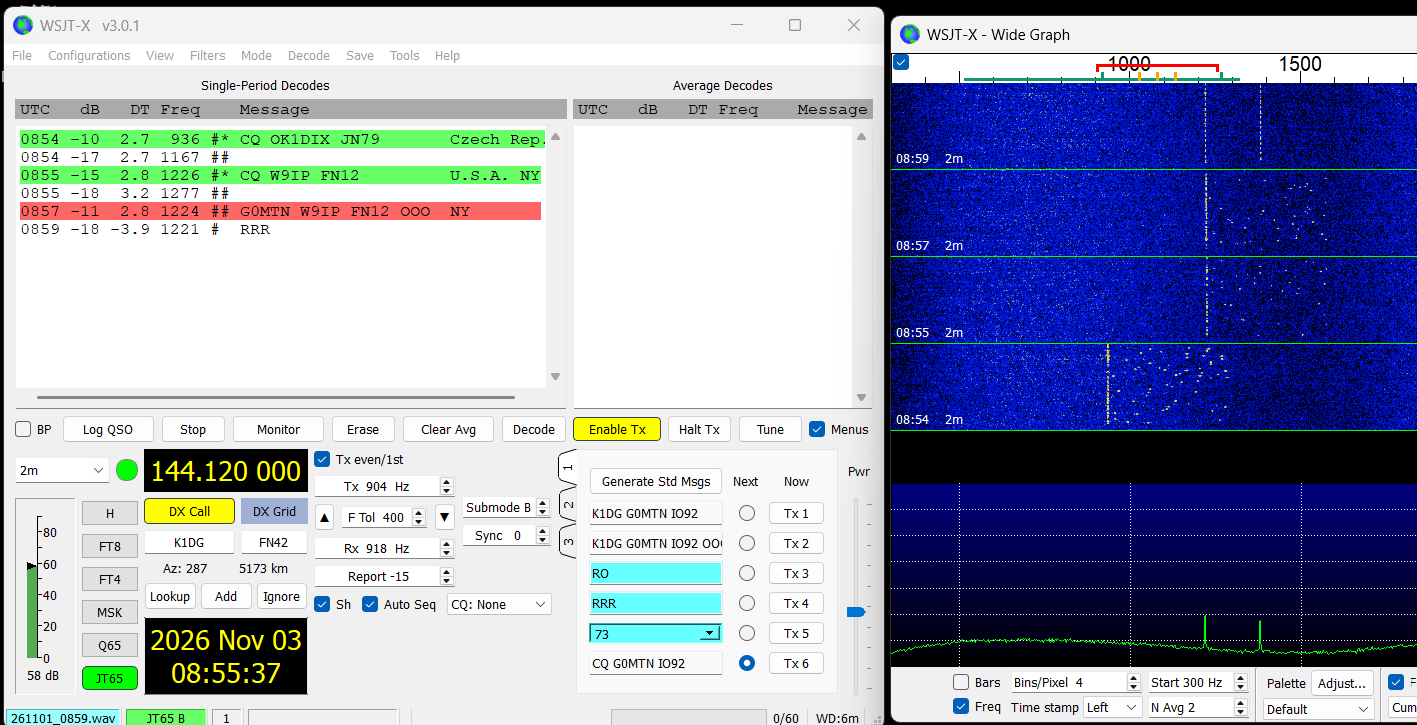
The digital mode used is JT65B, which has a transmit period of about 48 seconds every other minute.
Fortunately, after connecting everything together (admittedly some wiggling of coax connectors was necessary!) the station appeared to be working correctly. The SWR was low, and after a little while I'd found some EME signals.
There are several online chatrooms and the EME equivalent of PSK Reporter or the Reverse Beacon Network to help show where stations are active. As most signals will not be audible by ear, it's very useful to help work out what's going on and where and when to call.
With the round-trip path loss at 144 MHz being around 252 dB, my setup is right at the limit of being able to make QSOs. I am limited to hearing and working only the very biggest stations worldwide.
By adding a few more dB gain, this should open up possibilities for making contacts with more stations.
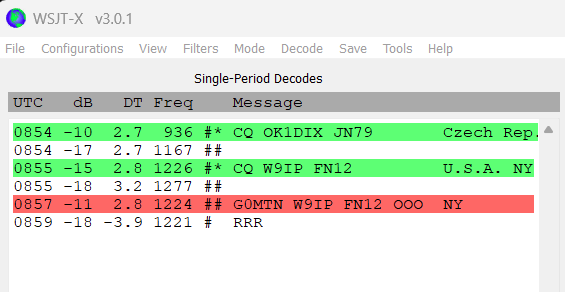
During this session, 4 contacts were made - 2 with the Czech Republic, and 2 with the USA. Several more were heard, and many more were active, but I just couldn't detect or decode them.
As the distance between the earth and the moon varies day by day, conditions do change. Also, things like Faraday rotation which causes the signal polarisation to change adds an extra challenge.
We can appreciate that changing from vertical to horizontal polarisation has a big impact on received signal strength.
Some EME stations have antennas for both vertical and horizontal polarisation, and either switch the polarisation as needed, or use circular polarisation to combat the effects.
I have submitted this small contest entry to the ARRL.
Overall, I'm pleased to see the station equipment still works. I'm thinking about improving the antennas next summer, but I'll still be in the small EME station category.